
The Comprehensive Guide to Resisting Overcommitment
Reclaim your agency in the workplace
By Katrina Spencer
$katleespe | @katleespe [Venmo]

Each section of this article has its own recorded audio. Click ‘play’ to hear Katrina read it out loud.
Author’s Note
My brilliant editor, Megdi Abebe, from whom all good things come, has developed the structuring of the text below in sections that can be read in any sequence: chronological or otherwise. As you read about evaluating overcommitment, you will encounter four major sections in the body of this article: (1) identify, (2) self-audit, (3) assess, and (4) respond. The sections below can help readers to recognize signs of overcommitment, encourage readers to consider commitments comprehensively, and provide readers with practical suggestions for managing service engagements.
— Katrina Spencer
What does overcommitment mean?
“to allocate (resources) in excess of the capacity for replenishment” (Merriam-Webster)
“to commit more than is feasible, desirable, or necessary” (dictionary.com)
“to bind or obligate (oneself, for example) beyond the capacity for realization” (thefreedictionary.com)
Introduction
It is early 2021 at the time of this writing and I am developing a lesson plan for an African art history instruction session, contemplating my contributions to a panel for library and information science (LIS) students at my alma mater, proofing a thematic blog post on Women’s History Month, registering for two conferences, performing outreach to my liaison group, attending multiple webinars a week, coordinating social media for a librarians of color group, awaiting the commencement of my committee service for distributing $100,000 of grants for equity, diversity, and inclusion projects at the University of Virginia, and priming to lead the last sessions of a reading group on disability studies. [I love the variety of work my field offers me.]
This is, of course, aside from pursuing car repairs, scheduling an appointment to file my taxes, trying to understand my air fryer, eyeing the stock market, getting enough sleep, scrolling through Tik Tok, listening to an audiobook, awaiting news of my eligibility for the COVID-19 vaccine, gleaning snippets of information about the second impeachment of Donald Trump, and occasionally taking calls from friends, family, and paramours. Does this sound like you?
I work as an academic librarian, and if librarians are a group that is inclined to accept requests for service, then I, and perhaps you, too, are very much on brand. I am learning, however, as I progress through my career, that setting restrictions and boundaries for one’s self is necessary. As a friend and mentor of mine, Dr. Susan Burch, once said, “Time is a limited resource.” As is energy. And attention. And compassion. [Learn more about compassion fatigue in Jacquelyn Ollison’s TedTalk.]
So while I do not promise I am always the best practitioner of the expansive advice listed below designed to avoid overcommitment, I trust it will help us all to consider new forms of setting boundaries in our lives. Most of this piece is testimonial, with further recommended reading at the end.
“ Take what serves you and leave the rest.”
First, let us name some of the forces that drive overcommitment - specifically, capitalism, which profits from the overextension of workers. The more we work, particularly without reward/incentive/adequate compensation and without rest/recuperation, the more this economic system benefits. “Bigger, faster, stronger” is a North American motto that we use in our technology, our athleticism, and our production lines. With capitalism’s pervasiveness, an indelible foundation of North American history, manifested in the form of chattel slavery, fruit of the Transatlantic Slave Trade, it is not so surprising that its tenets inform, touch, and shape countless industries, including library and information science. As Tema Okun points out in “White Supremacy Culture - Still Here,” urgency and restless productivity also inform the ceaseless grind culture that “[disconnects] us from our need to breathe and pause and reflect” (Okun 27). Obsessive work-related tendencies come at a cost-- a cost to workers and our quality of life, and resisting overcommitment is resisting capitalism. [See @donnellwrites’ TikTok for more.] [TRANSCRIPT]
As you navigate the portions of your life over which you have some modicum of control, I warmly recommend that you build in protective mechanisms and best practices. Know that you cannot be everything-- librarian, teacher, consultant, psychologist, editor, tutor, cheerleader, counselor, etc.-- to everybody all the time, nor should you be. While engagement with the communities we serve is essential to our success within LIS, more conversation, too, is needed to address what overcommitment looks like and ways to avoid it.

Let us start with the first, identify. In the earlier stages of my career, I was not able to recognize certain signs of overcommitment as they did not show up in practice as I would have expected. For example, previously an excessively cluttered calendar or a poor work evaluation may have signaled overcommitment to me. However, the former can actually reflect signs of meticulous, mindful, balanced planning and the latter can indicate any number of things, among them disengagement, distress, or even a human resources dispute. In truth, you can have free work space on your calendar and shining annual reviews while still being overcommitted.
The second major body section, self-audit, encourages readers to be honest with themselves about motivations that brought them to the LIS field, to be intentional about our career trajectory planning, and to make sure that we see librarianship as part of the whole of our lives. When we see ourselves as synonymous with librarianship, allowing it to be all-encompassing, we set ourselves up for drowning in an ocean of our own [and capitalism’s] design.
The third, assess, invites readers to strategically contemplate and anticipate gains yielded from professional commitments, to hold core duties close in mind, and to be alert regarding tokenism, sexism, and other forms of abuse that librarians of color who are women are likely to encounter.
Last, respond, offers strategies for declining commitments and/or offering partial engagement. As we cannot say yes to every opportunity that comes our way, here you are provided with an arsenal of tools that allow you to manage requests in ways that respect your boundaries and your capacities at any given time.
Identify
Prolonged overcommitment leads to burnout, which is why it is important to know what it looks like.
12 signs you are overcommitted
1. Working weekly hours outside of one’s set schedule to move projects forward
2. Needing to take vacation days to catch up on work
3. Checking work-related communication channels (email, Slack, etc.) when off the clock/in one’s “free” time
4. Lashing out and/or sensing irritation towards colleagues
5. Ignoring a regular regime of self-care for renewal and refreshment
6. Attending back-to-back meetings with no breaks in between
7. Avoiding contact with library users for fear of having to meet more needs
8. Needing to regularly/frequently apologize for email response delays and/or uncharacteristic emotional outbursts
9. Feeling frazzled/harried and/or desperate
10. Accruing vacation time that goes without use
11. Eschewing the initiation/proposal of any new/original ideas and/or invitations for fear of acquiring additional responsibilities
12. Being unable to identify/anticipate any desirable activities that are not related to work
Green lights vs red flags
We will start by identifying “green lights” and “red flags” that signal whether we should commit to new projects. If you already noted that many of the 12 signs listed above ring true for you, it may already be time to start declining invitations for engagement.
But first let us imagine you feel you are working at a steady and manageable pace and you receive an email that says something along the lines of,
Hi, [New-ish] Employee,I’m So-and-So from the Adjacent Department. Some of us are shaping a group to meet the needs of __________/address the lack of __________/anticipate inviting __________. We wanted to know if you might join us on this venture. Are you interested?Talk soon, So-and-so
✅ Green Lights
| ✅ You want to do it. |
| ✅ The work aligns with your long-term/seasonal goals and interests. |
| ✅ There's ample time to prepare and seek partnership(s). |
| ✅ There’s time to ask questions and receive answers. |
| ✅ Signs of progress and success are identifiable. |
| ✅ Your contribution is defined, including start and end dates. |
| ✅ The rewards are obvious. |
| ✅ You anticipate desirable growth from the experience. |
| ✅ It’s optional. |
❌ Red Flags
| ❌ You don’t want to do it/The request irritates you/You can’t find your enthusiasm. |
| ❌ Someone else is better suited for the role. |
| ❌ The request is urgent and has a tight timeline. |
| ❌ You are invited to add diversity to the team, i.e. tokenism. |
| ❌ The group served by the effort is unidentifiable or not your priority. |
| ❌ You’ve been asked to “collaborate,” but really to “lead/plan/decide/initiate/build/found/monitor/innovate/create/steer” or “take ownership.” |
| ❌ You smell a brewing of scope creep in the air. |
| ❌ You are overdue for a vacation. |
| ❌ The desired outcomes have not been identified. |
I must acknowledge that not everyone has the privilege, autonomy, decision-making power, confidence, or experience in their professional roles to determine what their work duties look like and/or which responsibilities are optional. I am writing this piece as a new area studies liaison and have been very fortunate to have a string of supervisors who have exercised wild amounts of respect for my autonomy, discernment, and how I route my own course.
A good deal of that comes from establishing a strong history of self-direction, consistent follow through, reliability, reciprocity, and the ability to honestly evaluate my successes and shortcomings. It also has a lot to do with having supervisors who are not threatened by me, are often pleased to see my growth, relish my appetite for novel engagements, and trust me. I would be willfully naive and insensitive to suggest that all or even the majority of librarians enjoy all of the freedoms that I do.
Knowing that work environments are as heterogeneous as the workers , let me offer several strategies that may help you to resist overcommitment and its natural byproducts: burnout, stress, and, as library dean Kaetrena Davis-Kendrick has identified it in her much lauded research, “low morale.” [See “The Low Morale Experience of Academic Librarians: A Phenomenological Study” for more.]
Self-Audit
Take some time regularly to reflect on why you joined this profession and how your role allows you to honor those motivations.
Take an eagle-eye view
-
Being relentlessly and unapologetically clear with yourself about the impetus for your work and your desired career trajectory can make accepting and declining new service requests all the easier. Evaluating new opportunities to see how closely they align with your grander objectives has the potential to be more effective when your “why” is concrete.
-
a. One challenge I encounter is that I allow my heart to be consumed by my writing projects, reading itineraries, and service engagements, which regularly rise to the top on my lists of desirable work. Sometimes these tasks are so appealing that I begin to lose sight of other obligations that are more routine but still necessary. For example, I have been writing book reviews for Resources for Gender and Women’s Studies for over five years. However, my dedication to the publication does not negate the fact that less exciting but necessary obligations are also “work,” for example, attending regular team and departmental meetings. When I am determining whether or not to take on a new service request, I need to consider all that is before me: conference attendance, check-ins with my supervisor, instruction, consultations, emails, scheduling, etc. All of these together represent what I am professionally tied to.
b. Consider reviewing the past engagements on your calendar seasonally. Have you noticed that you have attended five webinars in the last six weeks but have yet to update any of your LibGuides? Taking time to review where you are overdelivering and where you are underdelivering can help you make timely adjustments. -
Going above and beyond the call of duty is largely characteristic of women of color in service positions. At times we try to please and overcompensate for what we perceive as lack due to insecurity and/or impostor syndrome as generated and/or reinforced by institutional and sociocultural norms (Andrews) within a white supremacist society.
We attempt to prove that we are worthy of our place at the table, indispensable, and superhuman. The line of thinking is “If I take on more projects/work later/assume more responsibility in a new role, I’ll be better liked/better compensated/admired, valued, rewarded, and revered/more likely to secure a promotion/more warmly accepted in a profession drowning in whiteness.” Aside from these premises simply not being true, they can become pathological and lead to self-harm and burnout. Moreover, some colleagues jealously resent peers’ over-performance!
I have seen librarians who are stars in our field accept ever mounting labors with their backs bent under their weight. While there may be some measure of reward, which frequently comes in the form of name recognition and invitations to do more work <--[Read that again!], it is, without exception, at a cost. Often that cost manifests itself in their personal lives.
Therefore, I caution you to understand what your role is, what your supervisor and team expect of you, and what you expect of yourself. In my experience, it is in fact the last of these that have put me in precarious positions as I have stretched myself towards unrealistic achievement beyond my reach. I have no beef with the overachievers I observe. Sh*t, they are my clan. However, the closer I look at these CVs, which are towers of and testaments to industry, to my dismay, the more cracks and fissures are revealed. Ask yourself, then, when you take on “just one more” role of service, “What am I trying to prove and to whom?” Who benefits from having workers who feel so out of place that they are willing to overburden themselves with work to establish some form of identity?
-
We are surrounded by seasoned professionals whose job it is to share information. Ask your peers and mentors for advice on how they keep work manageable and stress low.
-
Sometimes you will realize that you have overextended yourself after having made a commitment. It is a difficult position to be in, particularly for those of us who would rather endure pain than renege on a promise. I have been there, and I try to keep the number of times this happens infinitesimal. However, there comes a time where we must reevaluate what we are dedicating our time to and some tasks and responsibilities must be sent to the chopping block.
For example, when you are juggling multiple instruction requests, a difficult reference query, conference attendance, and moderating a webinar, you simply may not have the presence of mind to take notes at the next board meeting. If you find yourself overwhelmed with duties, you can talk with your supervisor in an effort to collectively identify priorities and to determine what tasks may be released, delayed, divided, or redesigned to make the most salient work more feasible.
Separate work and leisure
-
Women from historically marginalized backgrounds, overachievers, and workaholics may need to be told this explicitly and repeatedly: identify worthwhile activities and engagements in your personal life that bring you joy, schedule them into your life, and stick to them.
Allow engagements that you enjoy to occupy your non-work related hours. For those of you who may over-identify with the profession, read this point again. And then once more. See more about rest and interrupting toxic cycles of overwork at Tricia Hersey’s The Nap Ministry. [And for a passionate and aggressively loving illustration, see Durand Bernarr’s TikTok.] [TRANSCRIPT]
-
I am not one to spend a lot of time looking over my shoulder trying to catch sight of my immediate peers’ activity, and I wonder if that is a mistake. I be laser-focused in these streets tryna get mine. However, when I do come up for air and take my blinders off, sometimes I realize I’m trailblazin’, doing laps around the track, when the race was merely a 100-meter dash. Maybe that’s too many mixed metaphors. Moreover, I am not being placed in competition with my colleagues. My point is that we can find ourselves outperforming those around us, and if that is consistently the case, we may need to adjust our output or our designated peer group.
-
a. If on a given Wednesday I have meetings scheduled at 11:00, 1:00, and 3:00, I do not accept any more meetings for that day, though requests do come in. Often, before additional requests come in, I block time off between the meetings so I can breathe, stretch, use the bathroom, eat, read, or focus on a long-term project. If you find yourself with meetings back-to-back and the inability to take care of your needs, use scheduled rests, breaks, cushions, and periods of nothingness to protect your peace and mental health. We are not meant to be “on” and running at all times.
b. If you work at a large, public institution like I do, you will find yourself on the receiving end of a good many emails, some you expect and others you never signed up for. Reduce the unwanted queries and offers by aggressively unsubscribing from commercial emails that ultimately become distractions. The likelihood is that you and your institution do not choose to make acquisitions based on unsolicited queries so you likely will not need sales representatives emailing you trying to push a product.
Assess
While obedience is rewarded in LIS, blind compliance is cultish and its expectation should be questioned.
Seek reward
-
a. Brace yourself: I know this is going to feel antithetical to who we are. Are you breathing? Sitting down? Okay. Read on. It is okay to ask, “What’s in it for me?” Are you able to identify what it is that you gain as the result of a specific engagement? If not, examine what is motivating you to say yes. If the answer is “habit,” “people pleasing,” or “Who will do it if I don’t?,” consider making some concerted efforts to re-situate and recalibrate. [See Devi Brown’s TikTok on this topic.] [TRANSCRIPT] When you ask yourself “Why am I doing this?,” answers along the lines of “This reflects the labor I want to be known for in this profession,” “This agrees with my values and my priorities,” and/or “I want to reciprocate in serving X because X also serves me” may in fact be the desirable ones.
b. Recall that in our society, work is typically carried out in exchange for compensation and it would be silly of me to pretend as though we live in a society that is not fiercely and unapologetically capitalistic. Does the labor that is being asked of you reflect a paid opportunity? Is it something someone else would be paid to do? If so, why not you? Dr. Kawanna Bright wrote,“Within academia, invisible labor often takes the form of women or faculty of color being asked to dedicate more time to service commitments related to diversity than to teaching and research work needed to earn promotion and/or tenure. This service work may include being asked to serve on numerous committees, acting as a mentor or adviser to minority students both within and outside of their program and supporting diversity initiatives. While these service activities are seen as necessary and important by the faculty and students of color, they do not receive the same level of reward or acknowledgement for this work.” (Bright 173)
If you are unable to articulate what you gain from an interaction, take a moment to be skeptical of your willingness to engage. Transactional motivations may be looser in our personal lives, but largely work in the United States is a transaction. Fobazi Ettarh’s writing on the concept of vocational awe highlights the erroneous “beliefs that libraries as institutions are inherently good and sacred” (Ettarh), and therefore, conversely, not exploitative. These often unspoken underpinnings within the profession push librarians towards altruistic, unrelenting, self-sacrificing service, which can leave us empty and drained.
-
If you are on the tenure track and/or shaping your efforts around promotion/a raise, keep the metrics used to determine your advancement close at hand and see if the service request will help you to advance your goals. If not, might there be another form of engagement that could better serve your aims?
-
Bartering services in a quid pro quo manner came up once for me. A colleague needed someone to judge an oratory competition at his event and I needed a stage designer for a trivia event at mine. When he asked if I could serve at his event, I told him I would if he could also serve at mine. Both of our needs were met.
Apply thematic boundaries
-
For many academic librarians, we were hired to serve a very specific group or two or three within the university/college community or several of them. Remember who your target audience is and shape the bulk of your efforts around meeting their needs.
-
Ask questions of the requestor and of yourself. For example:
What mentorship is involved in chairing this committee?
Does publishing on data science match the professional portfolio I want to develop and pursue?
How many meetings will be needed for this usability testing?
How engaged, accountable, and thorough is the leader on this project?
Do we have enough time to submit the upcoming deliverables?
-
Some of the requests and invitations you receive will be open-ended, meaning they do not come with a predefined role of “chair,” “convener,” or “member at large.” After doing some exploration and research, you may be able to select and vie for your own role within a group. So if you have a strong history with budgeting, you can ask to handle the monies as treasurer. Or if web design is your strong suit, you can claim that role on your team. If group work is generally onerous for you, make it less so by selecting your role.
Understand various forms of abuse
-
Hazing is an abusive and evaluative initiation process of bullying that occurs when new candidate members try to join a group. Because of our collective vocational awe and our inclination to believe that librarians as people and professionals are unerringly benevolent, we would never admit that hazing is ubiquitous to LIS culture, but it is alive and well in our cliquish profession. Essentially the implicit and perhaps subconscious question that guides LIS-based hazing is “How much unpaid, questionably rewarding labor are newbies willing to endure in order to ascend the ranks?”
In our field, this type of labor and networking precede prominence. Hazing is meant to test one’s allegiance to a group and dangles an ostensible reward before the enticed. The reward, dear friends, is more work. Prestigious work, status, roles, and partnerships, but more work, nonetheless. Senior LIS professionals know that the newest among us are largely eager to please, frequently unfamiliar with the service landscape, and looking to prove ourselves. This is one of the ways new LIS professionals become burdened with unglamorous roles, winningless exercises, fruitless committees, tiresome meetings, onerous appointments, and undesirable nominations. People will gaslight you with:
“Give back to the profession.”
What reciprocal relationship is being referenced here?“This will look great on your CV.”
Who are we trying to impress who is exclusively moved by service?“How can you be a librarian and not be a member of [massive professional organization]?” What does this organization provide that merits membership?
“We thought about who would be great at this role and your name came up.”
Did no one else want the role?If an invitation is coming from someone who you trust, has demonstrated interest in your career development, is mindful of your wellness, knows your career goals, and leaves room for you to say no, by all means, evaluate accordingly. However, if the invitation is coming from someone, especially a senior LIS worker, who hardly knows you and/or has a distant, perforated relationship with you, and, even more important, your reply is being hurried and you feel pressured, slow that process down and vigilantly examine what is being offered and what you might gain. While obedience is rewarded in LIS, blind compliance is cultish and its expectation should be questioned. In brief, make sure that the service roles you are accepting are a reflection of your will and agency.
-
My friend and mentor mentioned to me once that occasionally saying no to requests does not mean that they will stop coming in. She was right. In academic institutions, there will be no end to projects that need a variety of attention. Communicating that you are sometimes available, sometimes enthusiastic, and sometimes uninterested is fair and should be expected.
Moreover, I have a suspicion that exercising selective engagement makes one’s time more prized as a collaborator as opposed to saying yes to everything and everyone all of the time, which may make one appear less discriminating and perpetually available.
-
We are all influenced by broader patterns of the overarching sociocultural milieu, i.e. the hegemony. As bell hooks names it, ours here is a “white supremacist, capitalist patriarchy” and it has long thrived on gendered labor. This one, of course, can be especially wily to pin down as we are awash with an overrepresentation of women in our field.
However, if you find that more often than not you are being asked to lend a hand in cleaning up after a gathering and less often being asked to lead new library initiatives, think about what professional labor(s) you want to resist and what you want to embrace. If the request hinges upon invisible contributions intended to make sure “others live and work comfortably” (Arellano and Gadsby), and ultimately a male counterpart will take credit for the overall success of the project, you may be encountering sexism.
-
Be radically honest with yourself: how did you feel after covering your colleague’s shift at the reference desk? After picking up the food deliveries for the after-hours programming event? Appearing as a guest lecturer in your colleague’s class? Were you energized? Happily drained? Jazzed for the next encounter? Were you disconsolate? Embittered? Resentful? Did you feel that your contribution was honored and acknowledged to the extent it should have been? Did you feel used and abused?
In our field, assessment is valued. We collect data–quantitative and qualitative–to determine how we can improve our services and best meet the needs of our library users. Assessing how you feel matters, too. If your service engagements make you feel victorious and inspired, congratulations: you are on the right track. If they make you feel isolated, unseen, and overworked, it is time to examine any patterns or habits within or beyond your control that are leading to these outcomes.
Respond
To preserve our enthusiasm, productivity, creativity, and capacity to be responsive to our communities’ needs, we must seek balance and know when to say no.
Decline
-
Let me be clear about what I am advocating for here. I am imagining a scenario in which you already perform your required duties regularly and satisfactorily and a request for optional service reaches you. You are allowed to decline. Full stop. “Thank you for the invitation. I will not be available for this” is a perfectly acceptable response. [See @gloarmmer’s TikTok for a comedic and authentic illustration.] [TRANSCRIPT]
Note that this reply does not explain why you are unavailable. It does not invite negotiation. It is polite, succinct, and complete. If the recipient of your message bridles at this reply, know that you cannot take responsibility for everyone’s emotions. The rest of the items on this list are nothing if we do not acknowledge this one. Most everything else on this list will refer to some sort of negotiation with the self and others, but the power of “No” cannot be overlooked. I would encourage its highly selective use, but I would not go without it.
-
If you tend to prioritize pleasing others, you may need to remind yourself of this often. Develop a means by which you and your supervisor understand what work is required and what work is optional as it is not all the same. When declining a service request and/or request to speak, present, write, peer review, etc., remember that apologies, excuses, and explanations are not required, as seen in the title of Megan Leboutillier’s book, “No” is a complete sentence.
-
a. I was once told that “If it’s not an enthusiastic yes, it’s a no.” This applies to conversations we are having around sexual consent in our country. When we think about service requests and feel hesitancy, that feeling will likely clue us into our truest sentiments regarding engagement. Pay attention to the subtle inclinations towards reluctance and potential pangs of guilt. Often they are communicating something to us that we know but are reluctant to admit to ourselves and others.
b. When being “voluntold” into labor, remember that you can also ask for help. This term, “voluntold,” is a portmanteau of “volunteer” and “told” and refers to situations when a person in a position of power identifies a need, task, or project and assigns it to a subordinate whether or not the latter desires it. Work acquired in this manner can fall under the nebulous umbrella of “Other duties as assigned,” which appears in many of our job descriptions. During an Association of College and Research Libraries (ACRL) webcast, “An Insider's Guide to Preparing for Promotion: the Good, the Bad and the Ugly,” library director and former American Libraries Association (ALA) president Wanda Kay Brown referenced a scenario in which an employee with a dog phobia was being tasked to manage an event within the library that involved canines. Instead of declining coverage of the event, Brown recommended that the employee request a co-leader so that the programming need was met without exposing the worker who feared dogs to trauma. With this anecdote, the worker’s ability to voice limitations and negotiate tasks and responsibilities is illustrated. -
If you find that replying to an optional request for service, engagement, or attention is anxiety-inducing, taxing, and/or trying, know that silence or a lack of response is also an answer. Two good examples for appropriate scenarios in which ignoring requests is standard, par for the course, and even encouraged is when library vendors I have never met contact me requesting meetings to learn about my collection development habits and priorities as a selector or when researchers who have acquired my email address from public-facing pages want me to complete surveys or discuss their recently published works. To be clear, I believe strongly in reciprocal relationships in my personal and professional lives. I do not believe, however, in giving of my time, energy, and efforts to any and everyone who comes calling.
Participate without taking ownership
-
If a colleague says, “There’s an interdisciplinary class being offered that needs instruction. Will you plan the lesson with me? We can schedule a room, develop a pre-assignment for the students, integrate the latest tweets on the topic, and assess with Mentimeter, that cool audience engagement and survey tool. You in?,” you can reply with, “Great idea! Here’s what I can commit to: I’d be happy to make a 20-minute cameo and present the History Makers database that day. Let me know when I should show up.” Here’s another example of a partial yes: “I won’t be able to staff the fair with you this Thursday. What I can do is share the documented plans I used last year for the same event. I’ll attach them now.” These replies allow you to be transparent about the extent of your support and leave little room for miscommunication.
-
Again, it is okay to establish parameters for engagement, for example, with the following formula, “If you can X by Y date, then I can Z.” A colleague might ask, “Can you help me to set up the table and props at the resource fair?” A reasonable response is, “If you pull the items from the stacks and place them on the cart, I can meet you ready at the library exit at 4:00. How does that sound?”
-
Not all tasks, I am learning, require thorough excellence in execution. With some, you can make a list of what excellence would look like and what satisfactory completion would look like and then choose accordingly. For example, your LibGuide may need a list of thematic databases at this time and not a spooling reel of book cover images representing recent acquisitions. The latter is excellent, pretty, and engaging; the former is satisfactory, necessary, and useful.
-
In some scenarios, you will be the leader of the project and you will realize that wearing all the hats-- managing the schedule, the budget, the advertising, the assessment, et al-- is too much for any one person. When you are steering a group of colleagues, understanding the strengths of each person on your team can help inform how roles can be distributed. Surveying your colleagues’ interests in collectively defined roles and affording them the chance to set the pace for progress together demonstrates respect for their time, boundaries, skills, and outstanding obligations.
Consensus-based questions asked in a group like, “When should we expect to see the platform published?” and “Can we have everyone’s input on the draft by the [day] of [month]? Might a different date be better?” go a long way by making commitments communally negotiated and communally accountable. This technique of inviting others to name, define, and select their contributions prevents any one person, including the team lead, from carrying excessive amounts of responsibility for a project that needs a variety of personnel to be carried out.
Employ time boundaries
-
a. Identify the timeframes at which you will not be engaged in labor at all in agreement with your contract/job description/duties/responsibilities. For many, this will be after 5:00 p.m. on weekdays and for the course of the weekend. You can automatically decline invitations that fall within the timeframes that you are not obligated to engage with work.
b. Define your seasonal priorities. If instruction and outreach are your primary goals for the fall semester, for example, collections and maintaining reference resources can take priority in the spring and research might take place in the summer. Make sure that the optional service requests you accept and decline fall in line with the priorities You have established.
c. Determine how much advance notice you need for taking on new tasks and use your parameters as a default mechanism for accepting and declining requests. For example, a minimum of six weeks is a reasonable amount of time to shape a scavenger hunt or other programming event. If someone asks you to mount a program with only two weeks’ notice, you can decline and consider proposing a different date to carry out the request. -
a. We must normalize giving each other time to weigh new requests. If you have been invited to collaborate on an exhibit, for example, take the necessary time to consider your availability, bandwidth, and potential contribution. A request for service received on a Tuesday will likely still be there on Thursday. It is also unlikely that your performance is being measured on the speed of your response.
b. Moreover, at times you will not be able to respond within a 48-hour window. It is okay to reply with, “I can get back to you by X date.”
c. Additional acceptable responses that buy time include, “I’ll have to get back to you on that,” “I’ll think it over,” and
“If that’s something I am able to do, I’ll be sure to let you know.” -
If a colleague or supervisor of yours says, “You were very successful last year with initiatives of this kind and we’d like you to lead outreach planning for first-generation, transfer, commuting, and non-traditional students” and you can only do so with stipulations, say so: “I can do this for the academic year, August to May, but afterwards I’ll be attending a summer institute, June to August, and will be unavailable. I suggest the team name a replacement by April. I have just the idea for one programming event for each of the groups You have listed.” Note that this answer is affirmative and sets expectations of extensive but still limited engagement.
-
A colleague of mine once told me that she decided how many extracurricular service events she would attend in a given year and once that number was met, she made herself eligible to decline all following invitations. My mind was blown. I did not know you could do that. There was a student group that regularly invited me to participate on panels in the evening, attend mixers on Sundays, and even an annual gala. When I next wrote to them, I said, “I’ll attend three of your events this year. You choose which ones.” In doing this, I let them know that I supported their various efforts and that my time would be limited.
-
a. On some occasions, a shiny, golden, gleaming opportunity will present itself, quickly approaching on the horizon, and you will find yourself inextricably tied to other projects and obligations. It happens. In that scenario, you have the option of communicating to the new project lead when you can become engaged in the spectacular undertaking, if at all. That date may not be the same as the one initially suggested, and here is where negotiation comes in. Having contorted myself out of shape on more than one occasion to make myself available for opportunities I did not want to miss, I now recommend mindfully constructing timeframes that are comfortably feasible.
This is to avoid feelings of pressing urgency and to be more present for pre-existing obligations. Add some additional margin in your deadline design to anticipate hiccups and delays, too. Similar to a note that author Dorothy Berry made on this very platform in “The House Archives Built” when she wrote that we are the professionals who construct archival standards, at times, we are also the professionals with the agency to construct humane timelines. It is in our interest to recognize and seize the instances when we have the authority to shape and determine when work gets carried out.
b. Moreover, when the window for a glorious, recurring opportunity is closing too soon for comfort, we can make a note of it and choose to participate in its next cycle. It does not have to be right now. As Tema Okun writes, one feature of white supremacy culture is the idea of urgency-- the impression that work must be carried out as soon as possible else something be lost. Going slowly is not indicative of a lack of dedication. On the contrary: resisting the fictions of immediacy in our work is an act of self-preservation and a precursor of steady, deliberate, and meaningful engagement.
Conclusion
The goal of this guide is to help us to quicken our senses, to slow our reactions, and to encourage us to be proactive and intentional about what we say yes to. If my experience is true, there will be no end to service requests. However, there will always be a need to set boundaries and to check in with one’s self regarding willingness and availability for engagement.
A key to happily sharing one’s energy with others is ensuring that those same energy reserves are properly, adequately, and regularly restored. For many of us, in the earliest stages of our careers, we tend to be abundantly eager to please, hungry for experience, thrilled by the potential for collaboration with reputable parties, and often unable to identify patterns of abuse, exploitation, and self-harm. As we move along, we begin to compile, recruit, and retain strategies that make sustaining our careers, our balance, and our enthusiasm more tenable.
So, if you are “green,” as I once was, initiating projects, saying yes to every opportunity that darkens your door, and building an enviable dossier, I commend the beauty of your energy and both simultaneously and warmly recommend you bookmark this piece and refer to it again 18 months from now. Share it with the newest hires, those straight out of grad school with the brightest, widest eyes, and even the rose-colored glasses.
Acknowledgements: Megdi Abebe, Sofia Leung, Annie Pho, Dr. Aisha Johnson, Dr. Susan Burch, Twanna Hodge, Chris Ruotolo, Krystal Appiah, Joyce Gabiola
Peer reviewers: Sofia Leung, Annie Pho, Dr. Aisha Johnson
Works for further consultation
Andrews, Nicola. “It’s Not Imposter Syndrome: Resisting Self Doubt As Normal.” In the Library with the Lead Pipe. 10 June 2020.
https://www.inthelibrarywiththeleadpipe.org/2020/its-not-imposter-syndrome/
ayo, damali. How to Rent a Negro. Lawrence Hill Books, 2005.
Austin, Julia. “10 Polite Ways to Say, “Sorry. I Don’t Work for Free.” Madame Noire. 11 January 2021. https://madamenoire.com/1209438/how-to-get-paid/.
Bernarr, Durand. [@durandbernarr.] “Why are you not treatin’ yo’self?” TikTok, 2021, https://www.tiktok.com/@durandbernarr/video/7023950514937203973?is_copy_url=1&is_from_webapp=v1
Bright, Kawanna. “A Woman of Color’s Work is Never Done: Intersectionality in Reference and Information Work.” Pushing the Margins: Women of Color and Intersectionality In LIS. Edited by Chou, Rose L., and Annie Pho. Library Juice Press, 2018, pp. 163-196.
brown, adrienne maree. Pleasure Activism: The Politics of Feeling Good. AK Press, 2019.
Brown, Devi. [@devibrown]. “I am not available for anything that’s not mutually beneficial…” TikTok, 2021, https://www.tiktok.com/@devibrown/video/7010887914066431237?is_copy_url=1&is_from_webapp=v1
Brown, Wanda Kay, panelist. “An Insider's Guide to Preparing for Promotion: the Good, the Bad and the Ugly.” ACRL’s Equity, Diversity, and Inclusion Committee. 9 March 2021. https://youtu.be/IyyEjFhsJh0?t=3721
Donnell. [@donnellwrites.] “https://www.tiktok.com/@donnellwrites/video/7049507618305395973” TikTok, 2021.
Douglas, Veronica Arellano and Joanna Gadsby. “Gendered labor and library instruction coordinators: the undervaluing of feminized work.” Proceedings of the 2017 Association of College & Research Libraries Conference, American Library Association, 2017. https://www.ala.org/acrl/sites/ala.org.acrl/files/content/conferences/confsandpreconf/2017/GenderedLaborandLibraryInstructionCoordinators.pdf
Ettarh, Fobazi. “Vocational Awe and Librarianship: The Lies We Tell Ourselves.” In the Library with the Lead Pipe. 10 January 2018. http://www.inthelibrarywiththeleadpipe.org/2018/vocational-awe/.
Farkas, Meredith G.* “What Is Slow Librarianship?” Information Wants to Be Free. 18 Oct 2021. https://meredith.wolfwater.com/wordpress/2021/10/18/what-is-slow-librarianship/
Ford, Emily.** “How Do You Say No?” In The Library with the Lead Pipe. 16 Dec 2009. https://www.inthelibrarywiththeleadpipe.org/2009/how-do-you-say-no/
@gloarmmer. “I was just wondering if you’d be able to do this event for me...?” TikTok, 2021, https://www.tiktok.com/@gloarmmer/video/7020779918275398918?is_copy_url=1&is_from_webapp=v1
Hathcock, April. At the Intersection.---. “Goodbye, ALA.” 29 June 2021.
https://aprilhathcock.wordpress.com/2021/06/29/goodbye-ala/
---. “White Librarianship in Black Face.” In the Library with the Lead Pipe. 7 Oct 2015. https://www.inthelibrarywiththeleadpipe.org/2015/lis-diversity/
Hersey, Tricia. The Nap Ministry.
In the Library with the Lead Pipe.
Kendrick, Kaetrena Davis. “The Low Morale Experience of Academic Librarians: A Phenomenological Study.” Journal of Library Administration 57: 8, 2017, pp. 846-878. https://doi.org/10.1080/01930826.2017.1368325.
Leung, Sofia. “Letter to New People of Color in LIS.” In Our Own Voices, Redux: The Faces of Librarianship Today, edited by Teresa Y. Neely and Jorge R. López-McKnight, Rowman & Littlefield Publishing Group, 2018: 257-263.
@Lisabarian. “Me, a new librarian: I want to join everything…” Twitter. 16 March 2021, https://twitter.com/Lisabarian/status/1371831086746103813
Okun, Tema.*** “White Supremacy Characteristics - Still Here.”
https://www.whitesupremacyculture.info/characteristics.html
Ollison, Jacquelyn. “Compassion fatigue.” Tedx Talks. 13 November 2019.
https://www.youtube.com/watch?v=-Cmc-5sU5L4&t=130s
“Overcommit.” dictionary.com
https://www.dictionary.com/browse/overcommit. Accessed 7 Dec. 2021.
“Overcommit.” Merriam-Webster.com Dictionary, Merriam-Webster,
https://www.merriam-webster.com/dictionary/overcommit. Accessed 7 Dec. 2021.
“Overcommit.” thefreedictionary.com,
https://www.thefreedictionary.com/overcommit. Accessed 7 Dec. 2021.
Pho, Annie and Rose L. Chou. “Intersectionality at the Reference Desk: Lived Experiences of Women of Color Librarians.” The Feminist Reference Desk: Concepts, Critiques, and Conversations, edited by Maria T. Accardi, Library Juice Press, 2017, pp. 225-252.
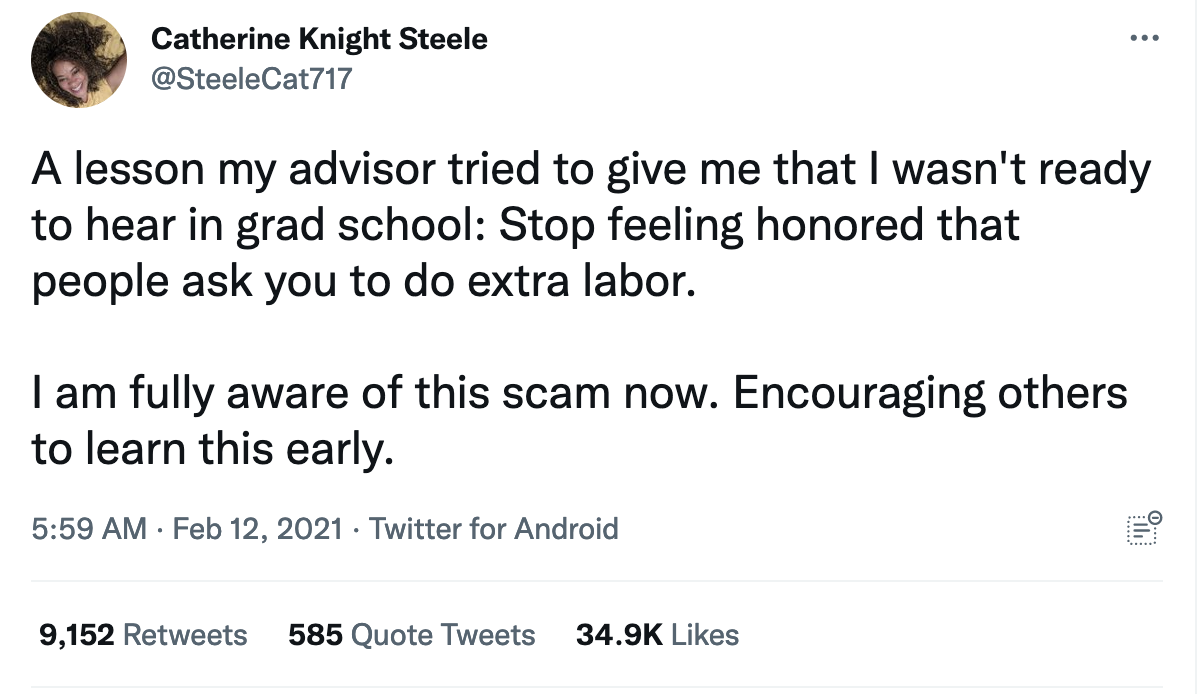
Steele, Catherine Knight [@SteeleCat717]. “A lesson my advisor tried to give me that I wasn’t ready to hear in grad school: Stop feeling honored that people ask you to do extra labor…” Twitter. 12 February 2021, https://twitter.com/steelecat717/status/1360226989223911428
Sut Jhally, et al. bell hooks: Cultural Criticism and Transformation. Media Education Foundation, 2018
*Meredith Farkas is a white woman whose writings support the idea of valuing relationships over measurable outcomes, the latter a preference of white supremacy culture.
**Emily Ford is a white woman whose writing also engages the need for library and information science workers to say no and resist excessive labor.
***I do not know Tema Okun’s racial identity, however, their writing on white supremacy culture is valuable and relevant to this discussion.